
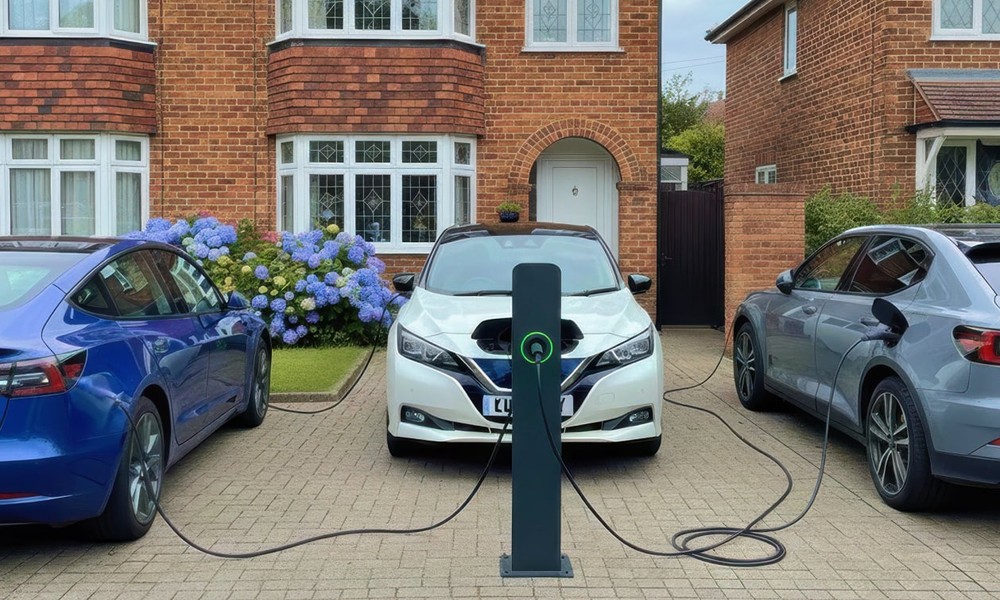
As electric vehicles become more common in Austin’s rapidly growing suburbs, many households are running into a new kind of problem that didn’t exist just a few years ago: not just charging one EV, but managing two or even three vehicles at home.
What used to be a simple “plug in the car overnight” situation is now turning into a real electrical planning challenge. Families with multiple EVs, plug-in hybrids, and future plans for more are quickly discovering that home charging isn’t just about convenience anymore-it’s about capacity, load balancing, and smart system design.
That’s where professional ev charger installation services become essential, especially in homes that weren’t originally designed for high electrical demand.
Why Multi-Car EV Homes Are Straining Residential Electrical Systems
Most homes in Austin, Texas suburbs were built with a 100-amp or 200-amp electrical panel in mind. That was more than enough for traditional loads like HVAC systems, kitchen appliances, lighting, and entertainment devices.
But EV charging changes the equation completely.
A single Level 2 charger can draw anywhere from 16 to 48 amps continuously for hours. Now multiply that by two vehicles charging overnight, and suddenly your electrical panel is working near its limit-especially if other major appliances are running at the same time.
This is where homeowners often start noticing:
- Breakers tripping unexpectedly
- Slow charging speeds
- EV chargers “sharing” limited power
- Lights dimming when appliances kick on
- Inconsistent charging schedules
Without properly designed ev charger installation services, these issues tend to get worse over time as more vehicles are added.
Understanding Panel Capacity: The Hidden Bottleneck
One of the most overlooked issues in EV-ready homes is panel capacity.
Your electrical panel is essentially the “traffic controller” of your home’s power. Every appliance, outlet, and system draws from it. Once demand exceeds safe capacity, breakers trip-or worse, wiring overheats.
In multi-EV households, electricians in Austin, Texas often find:
- 100-amp panels already maxed out
- 200-amp panels with no remaining breaker space
- Old subpanels not rated for continuous EV load
- Shared circuits that were never designed for EV charging
This is why professional ev charger installation services always begin with a full load calculation. It’s not just about whether a charger can be installed-it’s about whether your home can safely support it during peak usage hours.
Time-of-Use Charging: Saving Money While Reducing Load Pressure
One of the smartest strategies for multi-EV households is time-of-use (TOU) charging.
Utility companies in Texas often offer lower electricity rates during off-peak hours, typically late at night. This isn’t just good for your wallet-it’s also good for your electrical system.
When combined with properly designed ev charger installation services, TOU strategies help:
- Reduce peak load stress on your panel
- Prevent simultaneous high-demand charging
- Extend breaker and wiring lifespan
- Lower monthly electricity costs
For example, instead of charging two EVs at the same time at full power, a system can be programmed so:
- Vehicle A charges from 11 PM-2 AM
- Vehicle B charges from 2 AM-5 AM
This staggered approach significantly reduces electrical strain while still fully charging both vehicles overnight.
Load Sharing Systems: The Smart Solution for Multiple EVs
Modern EV charging technology has evolved far beyond basic wall plugs. Today’s systems include load sharing or load management features that are especially valuable for multi-car households.
Load sharing allows multiple chargers to communicate and distribute available power intelligently. Instead of each charger drawing maximum amperage at the same time, they “talk to each other” and adjust output based on real-time usage.
With professional ev charger installation services, homeowners can install systems that:
- Automatically balance power between two or more chargers
- Prevent overload without manually switching circuits
- Prioritize one vehicle when needed (e.g., morning commute priority)
- Optimize charging speed based on available capacity
This is especially useful in homes where upgrading the electrical panel immediately isn’t practical, but EV adoption is growing quickly.
When a Panel Upgrade Becomes Necessary
There comes a point where smart charging alone isn’t enough. If your household continues adding EVs-or if your current electrical panel is already near capacity-a panel upgrade may be unavoidable.
Electricians in Austin, Texas typically recommend a panel upgrade when:
- Total household load consistently exceeds 80% of panel capacity
- You cannot safely install additional dedicated EV circuits
- Breakers trip during simultaneous EV and appliance use
- You are adding a second or third EV charger
- The home still uses an outdated 100-amp service
In many cases, a 200-amp upgrade or even a subpanel installation is the best long-term solution.
A subpanel can be especially useful in garages or detached structures, allowing EV chargers to operate independently from the main panel load. This approach is often included in advanced ev charger installation services for growing families.
Subpanels: A Flexible Way to Expand Charging Capacity
A subpanel acts like an extension of your main electrical panel. It doesn’t increase total capacity by itself, but it redistributes power in a more organized way.
For EV-heavy households, a subpanel can:
- Dedicated EV charging circuits without crowding the main panel
- Simplify future charger additions
- Improve load balancing between home systems
- Reduce wiring complexity in large garages or workshops
In newer suburban homes around Austin, Texas, subpanels are becoming a common recommendation when homeowners request ev charger installation services for multiple vehicles.
DIY EV Charger Installation: Is It a Good Idea?
It’s tempting for handy homeowners to think EV charger installation is a straightforward DIY project-mount a unit, connect a circuit, and plug it in.
But in reality, EV charging is not like installing a standard outlet.
Here’s what DIY often overlooks:
- Proper load calculation for continuous electrical draw
- NEC code requirements for EV circuits
- Correct wire gauge selection for long runs
- Breaker compatibility and panel balancing
- Grounding and safety compliance
- Permit requirements in Austin and surrounding areas
Mistakes in any of these areas can lead to:
- Fire hazards
- Equipment damage
- Voided warranties on EV chargers
- Failed home inspections
- Insurance complications
That’s why most manufacturers and utilities strongly recommend professional installation.
Licensed electricians providing ev charger installation services in Austin ensure everything is up to code, properly permitted, and safely integrated into your home’s electrical system.
Why Professional Installation Matters More in Multi-EV Homes
The complexity increases significantly when more than one EV is involved.
A professional electrician doesn’t just install a charger-they design a system.
High-quality ev charger installation services typically include:
- Full home electrical load assessment
- Panel inspection and capacity planning
- Dedicated circuit installation for each EV
- Load management system setup (if needed)
- Optional smart charging scheduling integration
- Permit handling and code compliance
- Future-proof planning for additional vehicles
This kind of planning is especially important in Austin’s fast-growing suburbs, where homes are evolving quickly from single-EV households to multi-EV families within just a few years.
The Austin, Texas Reality: Growing Homes, Growing Electrical Demand
Austin’s suburban expansion means more larger homes, more garages, and more families adopting electric vehicles at the same time.
It’s common now to see:
- Two working professionals each commuting in EVs
- Teen drivers getting their first hybrid or EV
- Families planning for future EV adoption before it happens
- Homeowners adding solar systems alongside EV chargers
All of this increases electrical complexity inside the home.
That’s why experienced ev charger installation services are no longer just about convenience-they’re becoming a core part of modern home electrical design.
Final Thoughts
Multi-car EV ownership is quickly becoming the new normal in Austin suburbs, but home electrical systems haven’t automatically caught up. Without proper planning, households can easily run into overloaded panels, slow charging, or constant breaker trips.
The solution isn’t just installing more chargers-it’s designing a smart, scalable system that considers panel capacity, load sharing, time-of-use charging, and future expansion.
While DIY installation might seem appealing, EV charging systems are one of the few home upgrades where professional expertise truly matters. Licensed electricians providing ev charger installation services ensure safety, efficiency, and long-term reliability-especially as your household’s electrical demand continues to grow.
In a city moving as fast as Austin, Texas, the homes that stay ahead are the ones that plan their power the same way they plan everything else: for today, and for what’s coming next.
